What (Taylor's Version) Can Mean For the Future of Pop Music

By now, the whole world has caught on to Taylor Swift’s plan to re-record her masters. Announced in August 2019, the plan to re-record her first six albums after their sale to Scooter Braun’s Ithaca Holdings (and their consequent re-sale to Shamrock Holdings) is now in full swing, with Ms. Swift having successfully released two of her six stolen masters—April 2021’s Fearless (Taylor’s Version) and November’s Red (Taylor’s Version). These albums have topped the charts, starkly contradicting claims that re-recorded albums were doomed to flop and delighting people everywhere in the process. The remaining four albums are consistently being teased across social media platforms, and are widely anticipated. In short—re-recording her albums has worked. 

But more than being a brilliant and gutsy retaliation to a dirty legal move, the re-recording of Swift’s well-known old songs also represents a fundamental shift in pop music and modern mass-produced media as a whole. It’s no surprise to anyone that the modern music industry as well as modern media in general has become incredibly product-oriented— most dialogue centers around what will be released and when, and fans have become eager for “content” above anything else. This is not necessarily bad in and of itself, but it is incredibly interesting to see what Swift’s re-recorded music has begun to do. 

It’s given pop music permission to grow.  

Even the casual listener will notice that while many tracks on the re-recorded albums remain faithful to their counterparts on the original albums, many others don’t. There are “from the vault” tracks, which were previously unreleased songs from the time period of the original album, as well as remakes of old fan favorites. Fitting into both categories is perhaps the most famous example—the legendary ten-minute version of the cult favorite “All Too Well”. Originally a four-minute wistful track about lost love, the ten-minute version of “All Too Well” retains every word of the 2012 version, fitted neatly into a complicated, varied, tumultuous narrative of a relationship that grew and twisted and failed. The ten-minute version retains the wistful core of the original, but the darker elements that were subtly hinted at originally are fully fleshed out in the newer version, in long paragraph-like lyrical phrases like the ones explored in her folklore and evermore albums. It’s markedly different from Red’s original polished 2012 country-pop release. And, of course, it’s sung in Swift’s current voice. 

Most importantly, though, the whole world loves it. There were SNL performances, a full short film starring two very well-known actors with an in-person premiere, acoustic performances and Long Pond remixes. This is striking because, before the re-records began, no one expected that they would achieve more than a tiny fraction of the original records’ popularity, and yet people adore this. Some of this can be attributed to Taylor Swift’s star power, and more to clever marketing. But underlying all of that is a willingness by the audience to revisit previous creations and fully appreciate the changes that have been made, and that’s striking. 

Because in a fast-paced economic system that makes art for consumption, we often think of art as a final product and of artists as “content creators”. This isn’t evil in itself, of course, but a lot is lost when art is thought of as more of a product and less of a process. To an extent, thinking of creative arts as a linear process ending in a polished product is counterintuitive; anyone who has ever tried to create something knows that art is never truly finished. 

Swift’s success in re-recording her albums has shown that it’s entirely possible for both to be true. The commercial success of albums does not have to mean that they are never revisited; some of her best creations have come nearly a decade after their original release, and if she had stopped with the “final” version of RED in 2012, these startlingly masterful songs would not exist. Allowing her art to evolve has given a sharper and deeper meaning to what the songs originally were, and now that the public has received the re-recordings so well, perhaps it can signal a shift to this mindset in modern media as a whole. Hopefully, this will remind everyone of the magic that can happen when art is allowed to develop authentically, even after it’s passed its original deadline.

As I hit play on Red (Taylor’s Version) once again this weekend, I know it’s reminding me.


Thumbnail image via

Superstar Rina Sawayama’s Stunning Debut Album

No one is better at making songs you want than Rina Sawayama. A razor-sharp mastermind, Rina Sawayama is an explosive vision, a phoenix to behold. To say her work is meaningful is not enough; she cuts deeper and closer to the soul than any modern musical artist. She exposes the core of her Asian immigrant experience in the Western world, fixating unrelentingly on the psychological impacts of her identity and her unstoppable, authentic personality. 

Image via

Image via

Rina Sawayama’s much-anticipated debut album SAWAYAMA blazed into existence on April 17 against a milieu of political clashes, the COVID-19 pandemic, and society’s rush to salvage 2020. For a precipitous age, SAWAYAMA is an iconic staple of pop music. Emanating from every corner are underlying tones of familial pain, struggle, and finding herself—from the self that studied at a historic, privileged institution like Cambridge to the musical, exploratory, creative, and rebellious self. The Japanese-born British artist’s incredible talent has grown since she began taking over the global music scene with her critically-lauded Rina (2017), one of the best debuts in recent pop history and the highest reviewed album of the year. On October 27, Rina Sawayama made her U.S. television debut with a performance of the smash single “XS” on the Tonight Show with Jimmy Fallon:

SAWAYAMA consists of 13 tracks full of her criminally deep and soulful voice and standout lyrics that take advantage of a bold rock-pop sound, with highlights like “Dynasty,” “Comme des Garçons (Like the Boys),” “Snakeskin,” “XS,” “Bad Friend,” and “Chosen Family.”

The emotional core in her lyrics makes her art different and more meaningfully complex than just pleasing hooks: “Dynasty,” “Bad Friend,” “Commes des Garçons,” “Chosen Family,” and “Fuck This World” all tell stories about her intergenerational trauma, a painful friend breakup she initiated, the double standards of female confidence, the joys of finding an LGBTQ+ family outside of her blood family, and the complications of the improvable but disappointing state of our world.

“Snakeskin” sounds like Rina is her own pop group, full of confidence, edge, and addicting beats—the composition sounds a lot like Blackpink’s, for example—and features her mother speaking in Japanese. Pixels, as Sawayama’s fans are known, embrace Sawayama’s tendency to “make decidedly uncool things cool,” including her visuals.

Image via

Image via

Image via

Image via

Image via Twitter

Image via Twitter

Image via

Image via

“When I was starting out, I remember looking around being like ‘There's not a single Asian pop artist that I can name.’ Hayley Kiyoko was sort of coming in a bit, but I was like "I can't name people who have pushed their Asian-ness to the fore and made art out of it." There's so many artists now. The first step was me talking about the fact that there's no representation, and then the second step was just being as successful as possible doing something that I would be proud of.” Quote via

Image via

Image via

Brighton concert via

Brighton concert via

Among many highly talented, driven Asian artists who are looking to impose their creativity upon the world and spread representation and their art, Rina Sawayama obviously feels pressure, but her results despite fear and anxiety are a testament to her distinct talent and passion. “Being east Asian and trying to be a pop singer in the UK where there is no precedent has sometimes been quite hard,” said the South London-based Niigata-born musician and model. “There aren’t many east Asian singers in the western pop world.” She emerges bruised but triumphant like a phoenix amidst a new generational set of difficulties that comes from one narrative of birth and origin in the East and growing up most of her life in the West. 

You need to listen to the shiny joy that is SAWAYAMA. From personal experience, discovering her album six months after its release after waiting and many singles, listening will bless your Zoom fatigue away like it did mine. I love the pop rock ballads the most for their thoughtfulness, soothing sound, and the feeling that she is letting us into her consciousness, but there’s truly something in it for everyone.

Her work is so personal that it’s emblematic of a bright future where we can all be ourselves: not necessarily a standard canon of the Asian experience but simply art that is sourced from her, a Japanese-British woman. It conveys essential helpful truths lacking in global musical discourse, like her experience of her native Japanese culture with a Westernized gaze and her critique of the latter, how her confidence as a female is held to a double standard in my favorite track “Commes des Garçons,” as well as her fights with her mother. Sawayama’s greatest asset is that she is unafraid to be honest and faithful to herself; she lyrically, sonically, and visually embodies a necessary disregard for fear and irrelevant judgment, like in her luminous “Bad Friend.”

“[My music] is so fueled by thinking about what I and my mom would be proud of me doing because it was such a big risk to be a musician that I didn't want to sit around and do fluffy pop songs and hope it cut through. I knew that it took something like this to cut through, because there's just so much music out there now. Like so many things in life, it's driven by parental approval; so annoying.” Quote via

Image via

Image via

“STFU!” addresses Sawayama’s annoyance with microaggressions towards Asian women, yelling out her pain with grating nu-metal aggression. Her experience in the UK, which doesn’t have the American—albeit complex and confusing, à la model minority myth—narrative of the power of immigrants or as active of a national discussion around issues like racism, has helped her achieve new levels of race-related realizations that are groundbreaking. Sawayama studied psychology, sociology, and politics as a Philosophy, Politics, and Economics undergraduate and had to rationalize parts of her experience being othered by the Cambridge community despite living in the UK for 25 years. More recently, she’s challenged her citizenship-based disqualification from the BRITs and Mercury Music Awards, as she is British and has experienced most of her life in England though she has retained sole citizenship in Japan.

Such active xenophobia, stereotyping, and blatant racism prevalent in the music and fashion industry—plus the structurally ingrained sexism inflicted on young female artists—are challenging and inevitable but nevertheless could not stop Sawayama’s drive. Her music truly stands on its own as hyper-creative, visionary, and genuine in a way that speaks to the soul. Her endless chain of accomplishments like invitations to madebygoogle and Wimbledon, and her army of celebrity fans like RM, Jorja Smith and Charli XCX are mere testaments to her effort, skill, and success in achieving her goals.

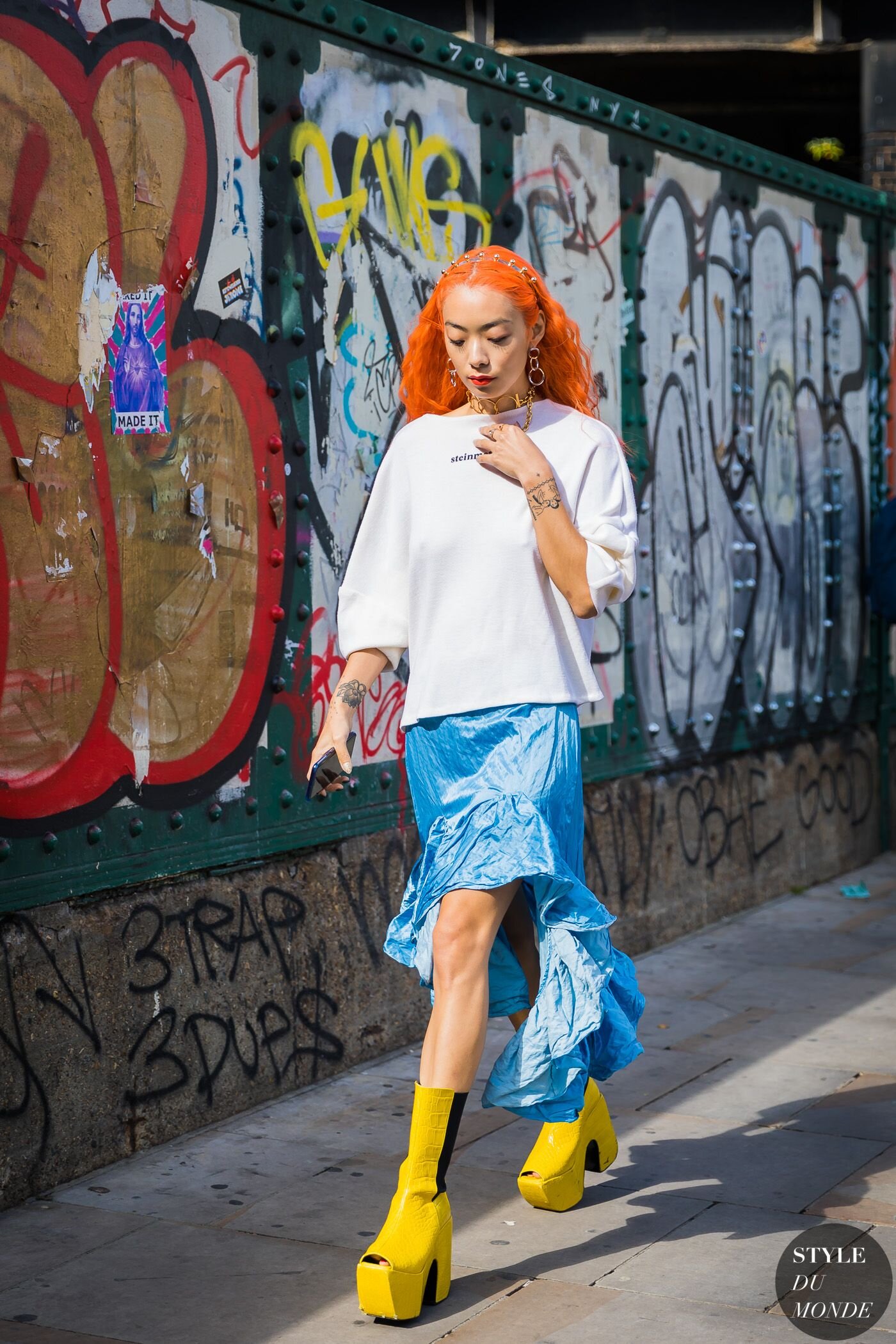
“Ultimately, I want a young ‘me’ to be able to feel like they can be the next east Asian model and singer with red hair and tattoos,” she said in an interview with Dazed.

Image via

Image via

Sawayama was born in 1990 and started dropping music in 2013 at exactly the same time as many third-generation Asian artists like international sensation BTS. She shares a similar drive and unrelenting strength in the face of countless obstacles, and even wrote a currently unreleased song virtually with BTS leader RM, who is a professed fan of Sawayama.

These comparisons between Asian diaspora artists and artists in Asia are to disprove the childish illusion that artists of Asian descent are in any way the same. BTS, with its utter global dominance despite tremendous financial obstacles and universal industry doubts, in fact stands as a good contrast for the differences in being an Asian immigrant as opposed to living in Asia. Sawayama had to create a songwriting and fashion career against a completely different set of challenges than BTS because of her unique context, such as racist producers who stereotyped her work as an expression of just “a general Asian story,” as well as rampant sexism since the earliest days of her songwriting career.

Rina Sawayama and collaborator RM of BTS via

Rina Sawayama and collaborator RM of BTS via

However, some commonalities BTS and Sawayama share despite much difference is a habit of firmly denouncing any prejudice in their professional lives and striving towards Grammy nominations. 

Sawayama doesn’t just want to make people dance, and cannot simply produce pop that is inauthentic to her because of her personal stakes and standards. Her music grips you with its energetic sound to make you listen to a compelling and stunning narrative, teaching you about what it means to find your own on your own. Anyone is welcome, she sings in “Chosen Family.” It’s your duty to hear from such a legendary teacher. She has unique values, strong personal emotions, and a nostalgic yet cutting edge pop sound. She is Rina Sawayama, and she can’t stop blazing blindingly bright.

Image via.

Image via


Feature image via.