Preparation Playlist: Preparing for Adele's 30

With the release of “Easy on Me” the first single for Adele’s newest studio album 30, the magnificently somber bells ring in the commencement of a new musical era for Adele. Following her previous studio album 25, released November 20th, 2015, her newest album is set to release nearly six years after the previous release (November 19th, 2021). The longest hiatus between album releases in Adele’s discography to date.

As a longtime fan of Adele and an outspoken appreciator of her almost unearthly ability to emotionally obliterate the masses with her vocal prowess, the promise of fresh music following the single — a nostalgic and somber piano ballad written for her son and ex-husband Simon Konecki following their divorce in 2019— leaves me on edge in anticipation for what Adele will present us next. So, to commemorate the long-awaited release and subsequent emotional distress, I was inspired to take a musical ride through Adele’s discography to reexperience the emotional highs and lows, and prepare for the release by creating a short preparation playlist that attempts to highlight a few of the many magnificent songs from each respective album starting from the beginning.

19

Released: January 28th, 2008

1. Chasing Pavements

Her first ever single released; “Chasing Pavements” should be regarded as a classic, as it is exemplary of what would become a key feature of Adele’s signature musical style. The song employs an earnest mix of pop and soul elements that compose a ballad with drastic shifts in intensity between each chorus and verse, but doesn’t lose its footing tonally. I find the lyrics in the heart of the chorus: “Or would it be a waste/ even if I knew my place?” especially resonant of this idea of “chasing pavements”. This idea of endlessly tiring over someone or something despite understanding your inability to succeed. Of knowing your place, but still questioning the value of continuing onward anyway.

2. Cold Shoulder

With its twinkly bounce, Cold Shoulder is an underrated gem that glimmers in its distinct optimistic sound countered with intense lyrics. “Cold Shoulder” is arguably different than what we expect from Adele, leaning into the experimental sounds and dipping into her lower register. Sound-wise, the song leans on tinkling bells and violin sounds. But similarly, uses slow, near lethargic musical breaks to punctuate the song. Throughout, Adele doesn’t flaunt her vocal power, but focuses on the smoothness of her voice. The song is simple in the best possible way.

21

Released: January 24th, 2011

3. Set Fire to the Rain

Despite only peaking at number 11 on the U.S Billboard Charts, “Set Fire to the Rain” is raw, unfurling with unadulterated vigor through impressive vocal bravado from Adele, and represents one of the best instances of Adele’s vocal talent. Loud and veracious, the song crescendos in an impassioned chorus that has become recognizable and draws listeners in with its unclenching power. Listening to this song, the rise from somber to empowered is captivating, and the song understands this, as it grows with each chorus. And on a personal note: the perfectly belt-able breakup song.

4. Rolling in the Deep:

One of Adele’s most recognizable songs, “Rolling in the Deep” deserves a spot on this playlist for the sheer impact alone. Being the catalyst for Adele’s commercial breakthrough and emergence into international spotlight, “Rolling in the Deep” shot Adele further into “stardom” following the success of her previous album 19. The song is an entrancing mix of blues, pop, and soul. A delicate, yet undeniably powerful thanks to Adele’s vocal range. Musically, it’s power lies in the expanding intensity through the songs many bridges to culminate in a final chorus that everyone has sang along to at some point. Additionally, the music video for “Rolling in the Deep” is spectacular. Combining artistic set, cinematography, and interpretive dance in a visual that compliments the song.

4. Turning Tables

One of Adele’s lower charting songs (peaking at 68 in the U.S.). “Turning Tables” is an enchanting ballad that relies on its strong piano track. A song about gaining power, this piano track is a striking underscore to Adele’s increasing intensity and is the highlight of the song. Starting slow and growing with the lyrics, the development of the piano track parallels the vocals, weaving seamlessly. I recommend this song simply for its musical construction, the piano track, and Adele, a cunning siren that you can’t help but move towards.

25

Released: November 20th 2015

5. Water Under the Bridge

Leaning into the pop elements of Adele’s music, the song opts to use drumbeats over piano. Unlike other songs, the use of multiple musical elements is a prominent feature—such as multiple layered tracks and drums— and a unique quality of the song. This isn’t to say the song lacks soulful quality, but pairs it with upbeat, pop adjacent sound to create a bouncier song. “Water Under the Bridge” is a good song to listen to casually. It fits itself into many playlists because of its musical versatility and ability to establish itself in the middle ground of soul and pop.

6. All I Ask

To start, “All I Ask” has a special place in my heart. I always cite it as my favorite Adele song, and I believe for good reason. This ballad encompasses the magic qualities essential to Adele and her music. Though provoking lyrics exploring the complexity of romantic relationships; unmatched vocal command; and a simple but rich piano track to score. The song culminates in an intimate song that is emotionally rich and musically beautiful, and exemplifies the power of Adele. Adele thrives in the simple and emotional, unchained by a necessity for intense musical production. There is no need for intense musical accompaniment, when Adele can prove the point through unfiltered emotion and otherworldly vocal technique.

Images via
Artists You Need To See Live, Post-Pandemic

What I miss most about pre-Covid era is being able to support my favorite bands in person and connect with other fans who share my passion for music. Inspired by artists scheduling upcoming shows, I have compiled a list of my favorite bands to see live!

89050DA9-BE72-4761-89C5-816BBFD5A4F7.jpeg

Thirty Seconds to Mars

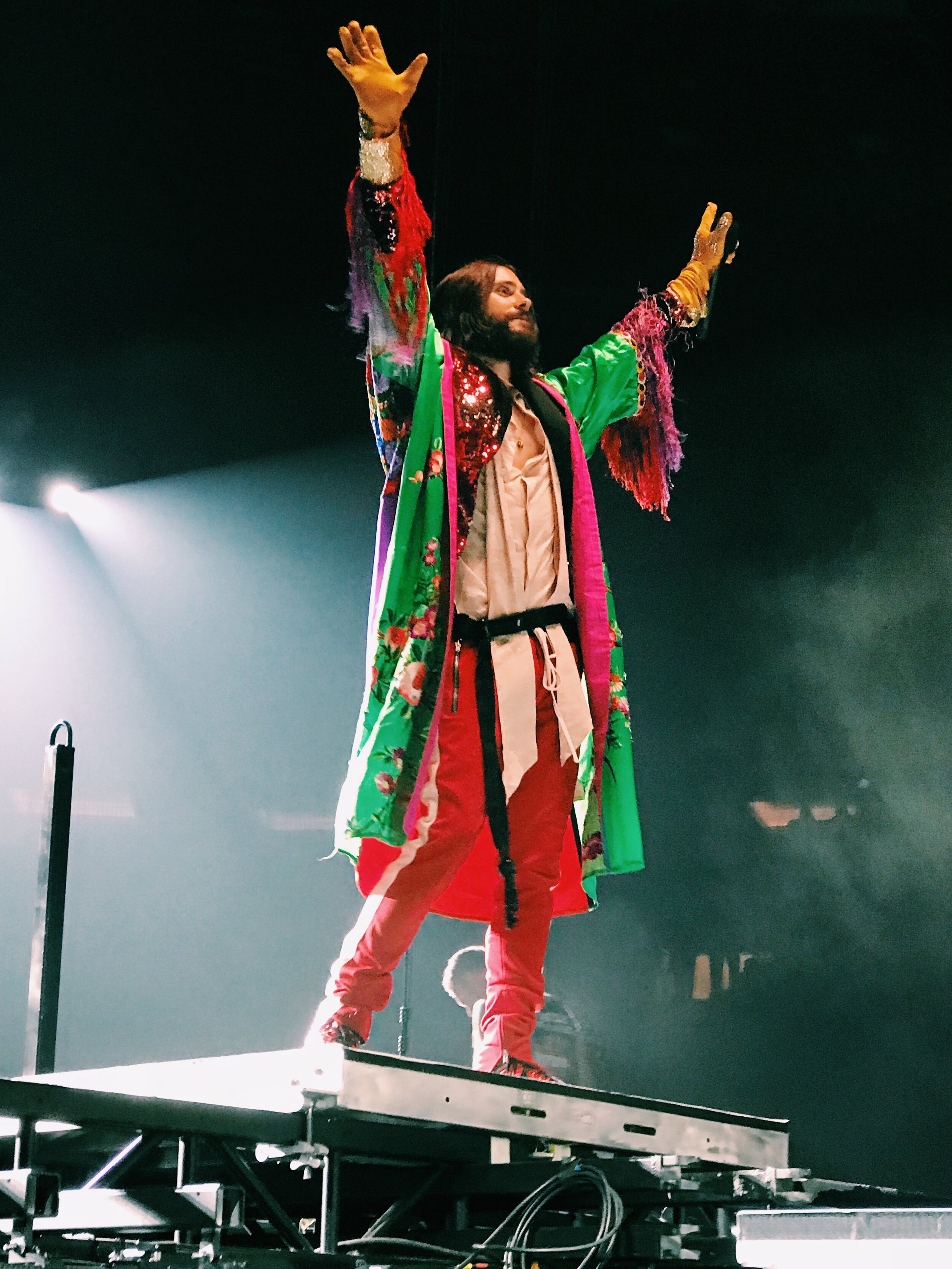
Thirty Seconds to Mars is the perfect show for every type of concertgoer. Whether you’re a diehard fan of the band or just want something to do on a Friday night, you’re bound to have an amazing experience at a 30STM show!

30STM is truly genre-bending in every sense of the word. They combine their most recent pop singles such as “Rescue Me” and “City of Angels” with their older punk hits like “The Kill” in a way that doesn’t feel forced. Meanwhile, Jared and Shannon Leto represent opposite spectrums in the fashion world: you’ll often see Shannon donning a Harley Davidson muscle tank while Jared is literally decked out from head to toe in Gucci apparel.

Most importantly, Thirty Seconds to Mars puts on a theatrical performance without sacrificing musicianship.

9B9FB598-6606-4469-9772-568EE8CC626E.jpeg

Muse

Muse concerts certainly have the best production value I’ve seen, whether it be high concept shows or more casual venues. Their latest tour for their album Simulation Theory immersed the audience in what felt like an AI dream. Somehow Matt Bellamy is shockingly able to maintain his insane vocal range and play guitar too (see “Knights of Cydonia”).

IMG_5855.jpeg

Don Broco

If you’re looking for a high-energy, no frills, small venue rock show, Don Broco is a must see. Their music is what I’d call “hype rock.” With bops like “T-Shirt Song” and “Everybody,” you’re sure to be dancing.

IMG_6940.jpeg

ONE OK ROCK!

If you’re looking to support an international band, I would definitely recommend ONE OK ROCK! They perform their English songs that you can sing along to but also their fast, heavier Japanese songs for a change of pace. It was also great to meet their diehard fans; I still remember someone screaming “takaaaa I love youuuu” after each song ended.

IMG_5905.jpeg

Mike Shinoda

Mike Shinoda’s show is great for concertgoers who are interested in or curious about lower profile rappers. Mike Shinoda was a member of Fort Minor (yes, as in “Remember the Name”). His new music, however, is focused on working through grief and his emotions following the passing of Chester Bennington, his bandmate in Linkin Park. Mike Shinoda provides a new and interesting perspective to rap which is definitely a must see.

B1ECF252-30D3-4491-842B-79C9F6A71991.jpg

Trivium

Trivium shows are not for the faint of heart. Be warned, if you’re in General Admission you will most certainly be squished by a sweaty crowd and forced to support body surfers making their way to the stage.

If this hasn’t scared you away yet, Trivium performances are truly a wild and exciting experience. Though I don’t love every song they play, I’m usually too caught up in the energy and adrenaline of the crowd to notice. If you want the full ~heavy metal~ experience, attend a Trivium concert at your local venue.


All images via Kaya Lee

Bring Concerts to You

Digital media has been winking at us from the doorway of the future for quite some time. We are getting absorbed into our mediatic worlds, screens, and, in a way, moving into our artificial embodiments, day by day. The popular notion of the “future” was just a matter of innovation, yet, with quarantine lingering and dragging everything behind, we happened to become social animals with a silly pun on the word social. Just when I said OK, I got used to these online classes, online clubs, online shopping, online, online, online...things, I witnessed friends having online therapies, online relationships, and more online things that once, supposedly and ideally, would have occurred face to face. I am not in a position to blame or glorify what we are witnessing now. However, I can talk about how I am, well, taking advantage of the situation.

Music is a must in my life. When one listens to music as much as I do, we inevitably begin to delve into its multifaceted world, slowly drifting away from the popular tracks and the good, old classics. Language barriers disappear. And this search for the unknown, a search that satiates the hunger for more, starts. Yet, when your playlists consist of music from more than a hundred countries, you obviously miss out on the concerts that happen all over the world. And, unfortunately, when you live in a place where none of the popular artists stop by in their tours (I am not even talking about that local indie group we all admired once), you start to look for solutions. Now, the very same solutions for the live shows conundrum apply to today’s quarantine situation.

For all my beloved friends that long for concert halls and any artistic medium of music, here are two of my alternative choices of music sharing platforms. Enjoy!

ONSTAGE K

ONSTAGE K is a Korean music-sharing platform that attracted me first because of its cubic aesthetic, which encapsulates the artists it presents. While Korean pop is dominating the music industry with its singers, dancers, and performers, ONSTAGE showcases contemporary artists that are as talented but less famous than mainstream K-pop bands. If you are looking for authentic, indie/R&B/Rock, chill, and energetic music performed by amazing artists with a live band in the background, creating this artsy and carefree atmosphere, I suggest you check ONSTAGE videos.

TINY DESK

The Tiny Desk Concerts idea came when a music editor was so frustrated after a concert that he couldn’t hear anything because the crowd was cheering all the time. Later, he jokingly suggested to Bob Boilen, the now host of the Tiny Desk, that he should invite artists to perform at his own desk (read the story). Well, history happened. Now, behind a “tiny desk,” in front of a silent crowd, world-wide musicians perform their tracks in the most instrumental way possible. Having more genre and language options than ONSTAGE, Tiny Desk is definitely a must-listen.

Hope you had a nice time!


Thumbnail image via

Superstar Rina Sawayama’s Stunning Debut Album

No one is better at making songs you want than Rina Sawayama. A razor-sharp mastermind, Rina Sawayama is an explosive vision, a phoenix to behold. To say her work is meaningful is not enough; she cuts deeper and closer to the soul than any modern musical artist. She exposes the core of her Asian immigrant experience in the Western world, fixating unrelentingly on the psychological impacts of her identity and her unstoppable, authentic personality. 

Image via

Image via

Rina Sawayama’s much-anticipated debut album SAWAYAMA blazed into existence on April 17 against a milieu of political clashes, the COVID-19 pandemic, and society’s rush to salvage 2020. For a precipitous age, SAWAYAMA is an iconic staple of pop music. Emanating from every corner are underlying tones of familial pain, struggle, and finding herself—from the self that studied at a historic, privileged institution like Cambridge to the musical, exploratory, creative, and rebellious self. The Japanese-born British artist’s incredible talent has grown since she began taking over the global music scene with her critically-lauded Rina (2017), one of the best debuts in recent pop history and the highest reviewed album of the year. On October 27, Rina Sawayama made her U.S. television debut with a performance of the smash single “XS” on the Tonight Show with Jimmy Fallon:

SAWAYAMA consists of 13 tracks full of her criminally deep and soulful voice and standout lyrics that take advantage of a bold rock-pop sound, with highlights like “Dynasty,” “Comme des Garçons (Like the Boys),” “Snakeskin,” “XS,” “Bad Friend,” and “Chosen Family.”

The emotional core in her lyrics makes her art different and more meaningfully complex than just pleasing hooks: “Dynasty,” “Bad Friend,” “Commes des Garçons,” “Chosen Family,” and “Fuck This World” all tell stories about her intergenerational trauma, a painful friend breakup she initiated, the double standards of female confidence, the joys of finding an LGBTQ+ family outside of her blood family, and the complications of the improvable but disappointing state of our world.

“Snakeskin” sounds like Rina is her own pop group, full of confidence, edge, and addicting beats—the composition sounds a lot like Blackpink’s, for example—and features her mother speaking in Japanese. Pixels, as Sawayama’s fans are known, embrace Sawayama’s tendency to “make decidedly uncool things cool,” including her visuals.

Image via

Image via

Image via

Image via

Image via Twitter

Image via Twitter

Image via

Image via

“When I was starting out, I remember looking around being like ‘There's not a single Asian pop artist that I can name.’ Hayley Kiyoko was sort of coming in a bit, but I was like "I can't name people who have pushed their Asian-ness to the fore and made art out of it." There's so many artists now. The first step was me talking about the fact that there's no representation, and then the second step was just being as successful as possible doing something that I would be proud of.” Quote via

Image via

Image via

Brighton concert via

Brighton concert via

Among many highly talented, driven Asian artists who are looking to impose their creativity upon the world and spread representation and their art, Rina Sawayama obviously feels pressure, but her results despite fear and anxiety are a testament to her distinct talent and passion. “Being east Asian and trying to be a pop singer in the UK where there is no precedent has sometimes been quite hard,” said the South London-based Niigata-born musician and model. “There aren’t many east Asian singers in the western pop world.” She emerges bruised but triumphant like a phoenix amidst a new generational set of difficulties that comes from one narrative of birth and origin in the East and growing up most of her life in the West. 

You need to listen to the shiny joy that is SAWAYAMA. From personal experience, discovering her album six months after its release after waiting and many singles, listening will bless your Zoom fatigue away like it did mine. I love the pop rock ballads the most for their thoughtfulness, soothing sound, and the feeling that she is letting us into her consciousness, but there’s truly something in it for everyone.

Her work is so personal that it’s emblematic of a bright future where we can all be ourselves: not necessarily a standard canon of the Asian experience but simply art that is sourced from her, a Japanese-British woman. It conveys essential helpful truths lacking in global musical discourse, like her experience of her native Japanese culture with a Westernized gaze and her critique of the latter, how her confidence as a female is held to a double standard in my favorite track “Commes des Garçons,” as well as her fights with her mother. Sawayama’s greatest asset is that she is unafraid to be honest and faithful to herself; she lyrically, sonically, and visually embodies a necessary disregard for fear and irrelevant judgment, like in her luminous “Bad Friend.”

“[My music] is so fueled by thinking about what I and my mom would be proud of me doing because it was such a big risk to be a musician that I didn't want to sit around and do fluffy pop songs and hope it cut through. I knew that it took something like this to cut through, because there's just so much music out there now. Like so many things in life, it's driven by parental approval; so annoying.” Quote via

Image via

Image via

“STFU!” addresses Sawayama’s annoyance with microaggressions towards Asian women, yelling out her pain with grating nu-metal aggression. Her experience in the UK, which doesn’t have the American—albeit complex and confusing, à la model minority myth—narrative of the power of immigrants or as active of a national discussion around issues like racism, has helped her achieve new levels of race-related realizations that are groundbreaking. Sawayama studied psychology, sociology, and politics as a Philosophy, Politics, and Economics undergraduate and had to rationalize parts of her experience being othered by the Cambridge community despite living in the UK for 25 years. More recently, she’s challenged her citizenship-based disqualification from the BRITs and Mercury Music Awards, as she is British and has experienced most of her life in England though she has retained sole citizenship in Japan.

Such active xenophobia, stereotyping, and blatant racism prevalent in the music and fashion industry—plus the structurally ingrained sexism inflicted on young female artists—are challenging and inevitable but nevertheless could not stop Sawayama’s drive. Her music truly stands on its own as hyper-creative, visionary, and genuine in a way that speaks to the soul. Her endless chain of accomplishments like invitations to madebygoogle and Wimbledon, and her army of celebrity fans like RM, Jorja Smith and Charli XCX are mere testaments to her effort, skill, and success in achieving her goals.

“Ultimately, I want a young ‘me’ to be able to feel like they can be the next east Asian model and singer with red hair and tattoos,” she said in an interview with Dazed.

Image via

Image via

Sawayama was born in 1990 and started dropping music in 2013 at exactly the same time as many third-generation Asian artists like international sensation BTS. She shares a similar drive and unrelenting strength in the face of countless obstacles, and even wrote a currently unreleased song virtually with BTS leader RM, who is a professed fan of Sawayama.

These comparisons between Asian diaspora artists and artists in Asia are to disprove the childish illusion that artists of Asian descent are in any way the same. BTS, with its utter global dominance despite tremendous financial obstacles and universal industry doubts, in fact stands as a good contrast for the differences in being an Asian immigrant as opposed to living in Asia. Sawayama had to create a songwriting and fashion career against a completely different set of challenges than BTS because of her unique context, such as racist producers who stereotyped her work as an expression of just “a general Asian story,” as well as rampant sexism since the earliest days of her songwriting career.

Rina Sawayama and collaborator RM of BTS via

Rina Sawayama and collaborator RM of BTS via

However, some commonalities BTS and Sawayama share despite much difference is a habit of firmly denouncing any prejudice in their professional lives and striving towards Grammy nominations. 

Sawayama doesn’t just want to make people dance, and cannot simply produce pop that is inauthentic to her because of her personal stakes and standards. Her music grips you with its energetic sound to make you listen to a compelling and stunning narrative, teaching you about what it means to find your own on your own. Anyone is welcome, she sings in “Chosen Family.” It’s your duty to hear from such a legendary teacher. She has unique values, strong personal emotions, and a nostalgic yet cutting edge pop sound. She is Rina Sawayama, and she can’t stop blazing blindingly bright.

Image via.

Image via


Feature image via.