"In This Together" : Vogue Announces Entirely Self-Photographed June/July Issue

It’s almost noon, and I’m finishing my black eyeliner - having only just woken up. And I realize that this might be a little silly. I’m getting ready for an online Russian grammar test. And I have no plans to interact with anyone other than my parents and little brother today. I’m still social-distancing, after all.

However, despite my realization that this might be a little silly, I still finish my makeup. And everyday since I began my quarantine, I have done so. I find it calming. The routine makes me feel productive. Even though I’m only preparing to sit in front of my laptop at my bedroom desk, I still want to feel prepared. I want to exercise some control over my life - no matter how small. And this helps me with that.

A few hours later, I read Anna Wintour’s April 23rd announcement, and I find myself equally calm. In her article, Anna shares the early launch of Vogue’s June/July Special Issue. (The official release is still scheduled for next month.) And even in a climate of utter uncertainty, it seems that Vogue has found a way to highlight what matters: community. As Anna writes herself, “we are all in this together.”

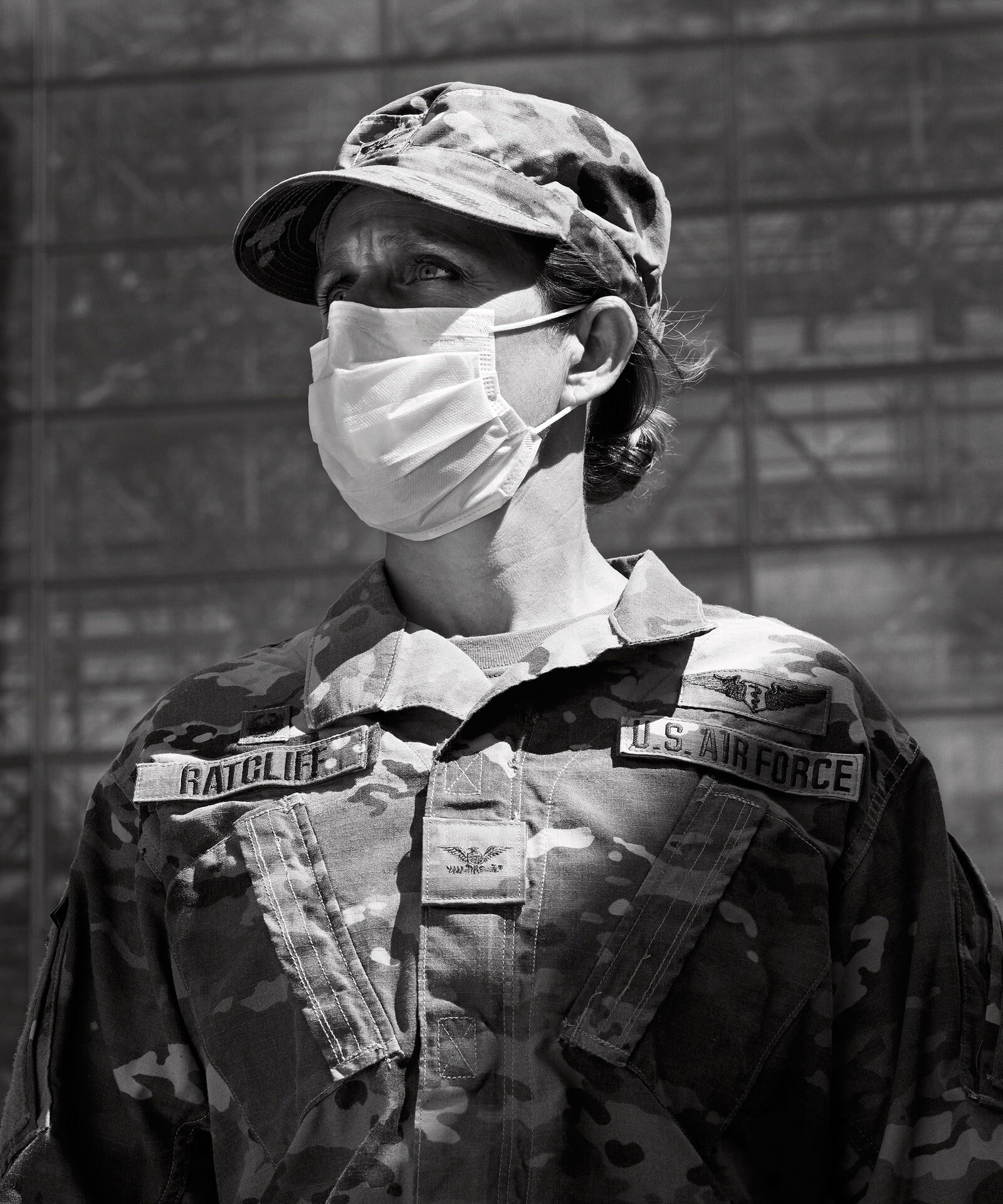
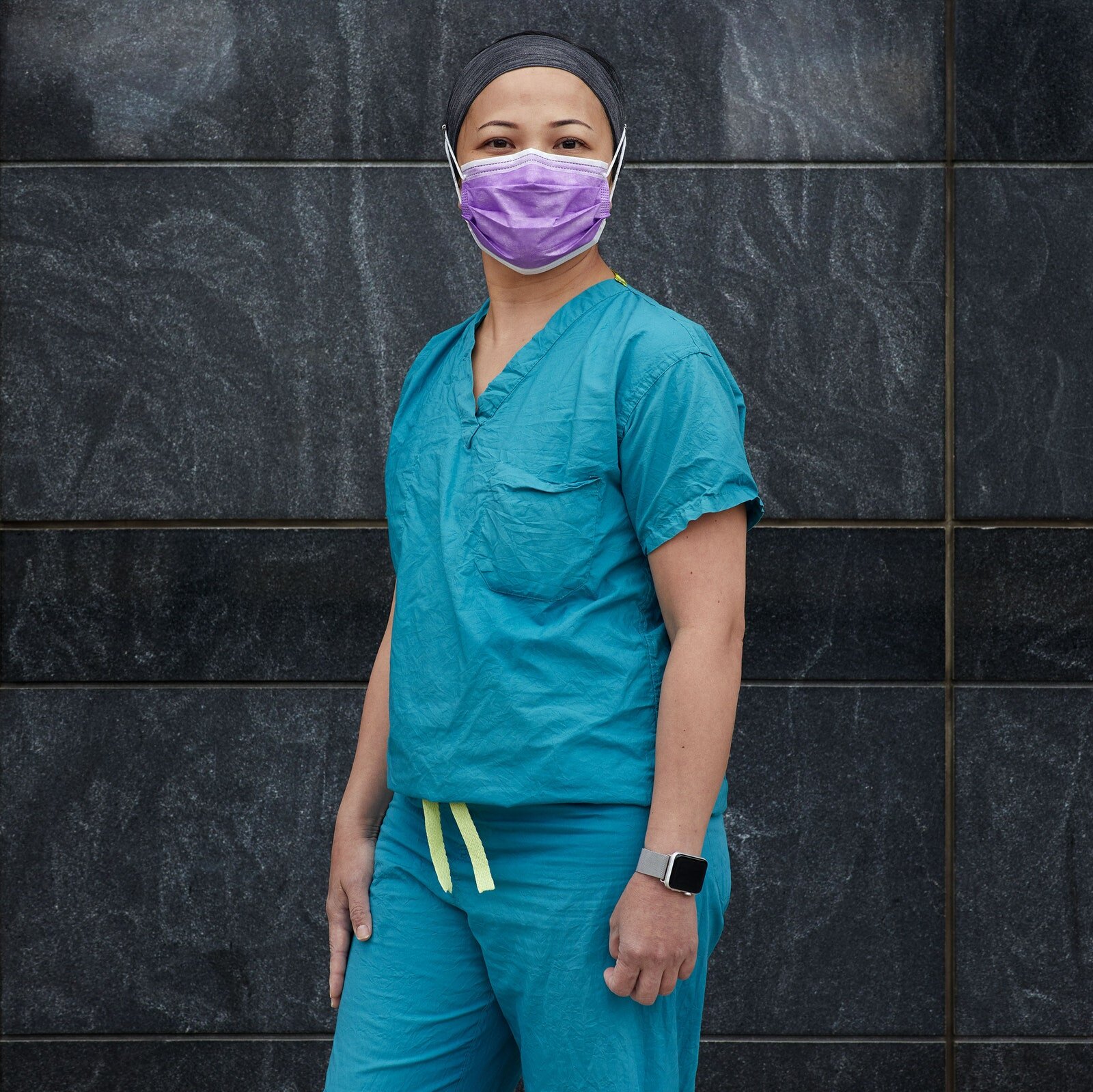
Anna begins her article by sending well wishes to her readers, before expressing her deep gratitude to the many first responders, who continue to bravely protect our communities. And she shares photographs from Ethan Green’s recent series, in which he provides an homage to these first-responders. Green’s photographs feature just a handful of health-care professionals, many of whom came from across the country, in order to help NY’s overwhelmed local healthcare system. The photographs were taken near the Javits Center’s temporary field hospital.
Furthermore, Anna also announces that Vogue’s June/July Issue will be special, in that it’ll be entirely self-photographed. And a portfolio of such self-photographs has already been released online. This is new territory for Vogue. Everything in the issue will be commissioned, designed, and produced remotely. And Anna hopes that the issue will serve as a historic and “poignant reminder of how we are all acutely missing the miracles of everyday life and the joy that they can bring.”

The cover of Vogue’s Special Issue features Irvine Penn’s formerly unpublished photograph, Rose ‘Colour Wonder’ (1970). It’s Vogue’s very first still-life cover in over 50 years.

The cover of Vogue’s Special Issue features Irvine Penn’s formerly unpublished photograph, Rose ‘Colour Wonder’ (1970). It’s Vogue’s very first still-life cover in over 50 years.

And as I flip through Vogue’s portfolio of self-portraits, I immediately connect with the words of Daniel Arnold, a nomadic photographer from NY: “I feel like I’ve been on an airplane for six weeks. I cry without being sad or moved, all of my emotions are mutedly haywire; I snack psychotically and I stare out a window, unable to digest how high up I am, or how dangerous it would be to go outside.” While Arnold’s quotation is dramatic, he has a point. I do feel a little bit like I’ve been on an airplane for weeks.

However, the more I study Vogue’s portfolio, the more I realize that Anna might have overlooked something. After all, while I do acutely miss my life “pre-coronavirus,” I also know that the joys of everyday life do not end under quarantine. These are tough times. They are bleak. But they do not have to be wholly hopeless - and there are many ways in which we can still notice, and enjoy, the many small moments that compose our lives.

This is exemplified by Vogue’s own work. In Vogue’s portfolio of self-photography, Sienna Miller discusses baking, swinging, and doing makeup with her little girl. British photojournalist, David Hurd, discusses his morning coffee - and how much he enjoys watching the birds outside his cottage window. Florence Pugh discusses gardening and cooking. And Steven Klein shares an awesome photo of his four-year-old son, surrounded by his stuffed animals.

Steven Klein’s contribution to Vogue’s Issue features his son, Ace, as he plays with his toys in Long Island, NY.

Steven Klein’s contribution to Vogue’s Issue features his son, Ace, as he plays with his toys in Long Island, NY.

For the first time in my life, my dad is home when I go to the kitchen for lunch. He helps me understand my biology homework. My mom brings me iced tea in the mornings, and we often sit on the patio together. She reads drafts of my writings - and we talk about them in person, rather than over the phone. In the evenings, I make salads while she cooks. And my parents have even started a garden - and my mom was excited this week, when the first plants began to sprout. Meanwhile, I converse with my brother between classes. And I realize just how much less time I’ve spent with them since I began college - and just how much time I suddenly have, to try to make up for what I’ve lost.


As Anna concludes her article, she writes that “[i]t’s a brave act to optimistically consider the future.” And she’s right. But, even more than that, it’s a brave act to optimistically consider the present. And if doing my makeup in the mornings (or afternoons) helps me do so, then so be it. In his contribution to Vogue’s Issue, Marc Jacobs may say it best:

I never thought a dress was a solution to a problem, but I do believe that as long as people are human, they’ll want to dance and they’ll want to get dressed and they’ll want to eat good food and they’ll want to engage in things that give them pleasure. I guess we just have to find a balance, or maybe rethink what all those things mean. But we all should be thinking about how we can change—or what we learned from this experience.
— Marc Jacobs

Click here, for thumbnail image source; Ethan Green’s photograph features Tanzania Johnson, a Navy hospital corpsman and respiratory-therapy technician, who actively works to address the coronavirus.
When Practice Exposes the Dangers of Theory: The Murder that Inspired Hitchcock's "Rope"

“That’s great in practice, but does it work in theory?”

And so might have begun the heinous plot of two UChicagos students in 1924. Nathan Freudenthal Leopold Jr. and Richard Albert Loeb became friends when they went to school together at the University of Chicago. As the child of a very wealthy Jewish family, Leopold had an IQ of 210 and spoke his first word when he was four months old. He graduated from UChicago with academic distinction, and he planned to attend Harvard Law. Similarly, Loeb was the son of the former president of Sears, Roebuck & Company. At the age of 17, he made history as the youngest graduate from the University of Michigan. As such, both men grew up in very wealthy, educated families on Chicago’s South Side. Both men were known for their “intelligence.” And both were obsessed with crime.

Loeb was typically lazy, but he spent an inordinate amount of his time reading crime novels. Meanwhile, Leopold dreamed of becoming one of Frederick Nietzsche’s “Übermensch.” Leopold honestly believed in, and internalized, Nietzsche’s theory that society possesses some “superior” men - or Ubermenschen - who are somehow above the dictates of society. In other words, Leopold believed that he was entitled to rebel against the normal constraints of morality. He believed that he could, and should, act “beyond good and evil.”

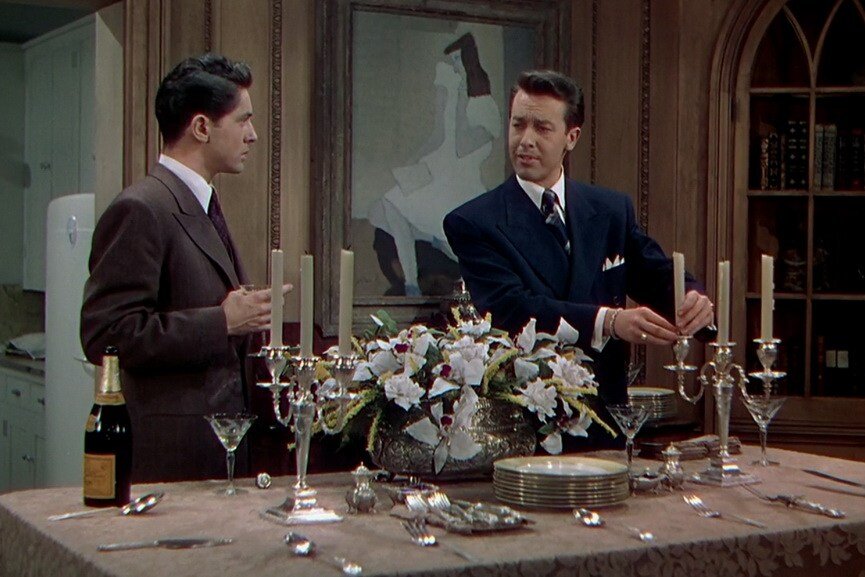
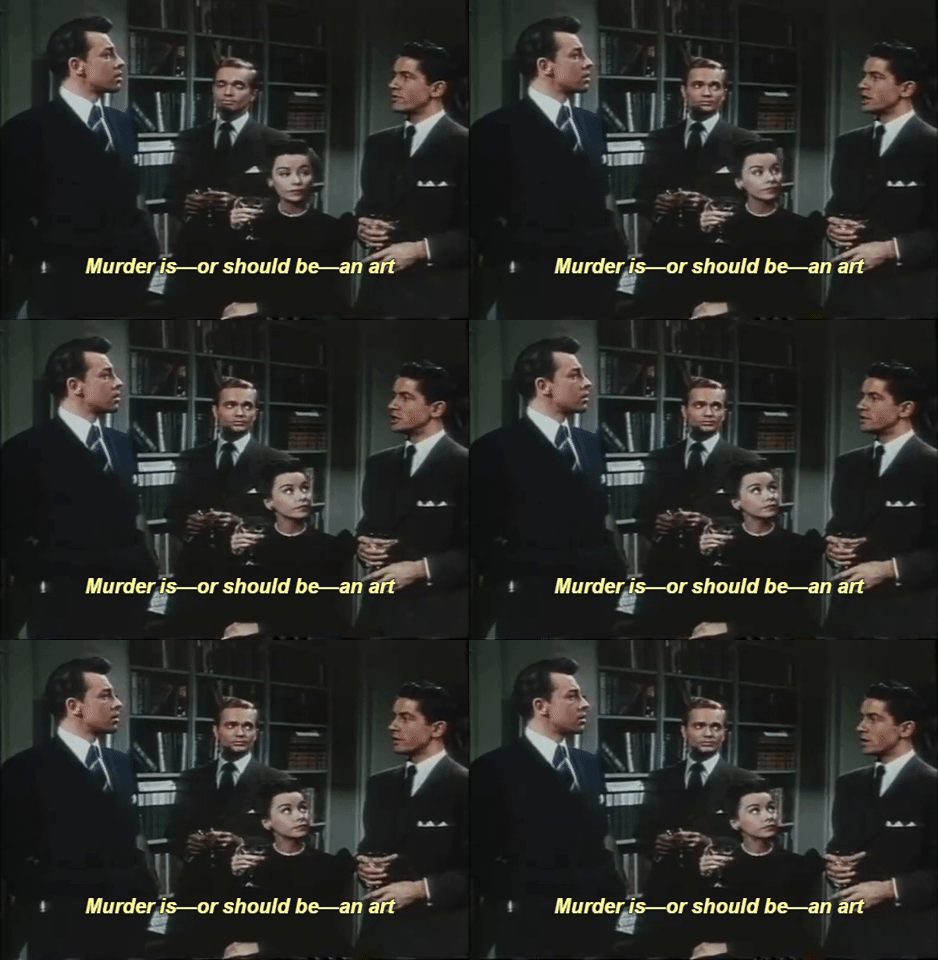
A quip from Alfred Hitchcock’s 1948 movie, “Rope.”

A quip from Alfred Hitchcock’s 1948 movie, “Rope.”

Leopold soon convinced Loeb that he too was an Ubermensch. They began committing vandalism and theft. But, they believed that they deserved more media attention than they were receiving. And so they decided to commit the “perfect crime” - as a trophy to their “superior” intellects. And in 1924, Leopold and Loeb kidnapped and murdered a 14-year-old boy, named Robert “Bobby” Franks. Leopold and Loeb convinced Franks to get in their car, as he was walking to school. And they murdered him with a chisel.

Eight days later, Leopold and Loeb were put into custody. They were sentenced to life in prison, plus 99 years for murder and kidnapping. And it turned out that they were neither supermen, nor were they infallible. They were not above the law, as they professed. They were not untouchable. And their heinous, unthinkable crime was not a trophy; instead, it became the representation of three lost lives. Leopold and Loeb atrociously ended the life of Franks, and they also threw their own lives away.

And I will not include pictures of Leopold and Loeb. Nor will I include graphic details of the crime they committed. Such details can be easily obtained from other sources, and that is not the purpose of this article. Nor is the purpose of this article to somehow glorify or romanticize Franks’ murder. On the contrary, I hesitated in writing this article, because I did not want to give Leopold and Loeb any satisfaction of media attention - even after their deaths.

Instead, I wrote this article because the story of Franks’ murder is important. While I’d argue that only a true sociopath could commit Leopold and Loeb’s crime, it is nonetheless worthwhile to emphasize the danger in believing - even momentarily - that any man is somehow above the constraints of morality or the law.

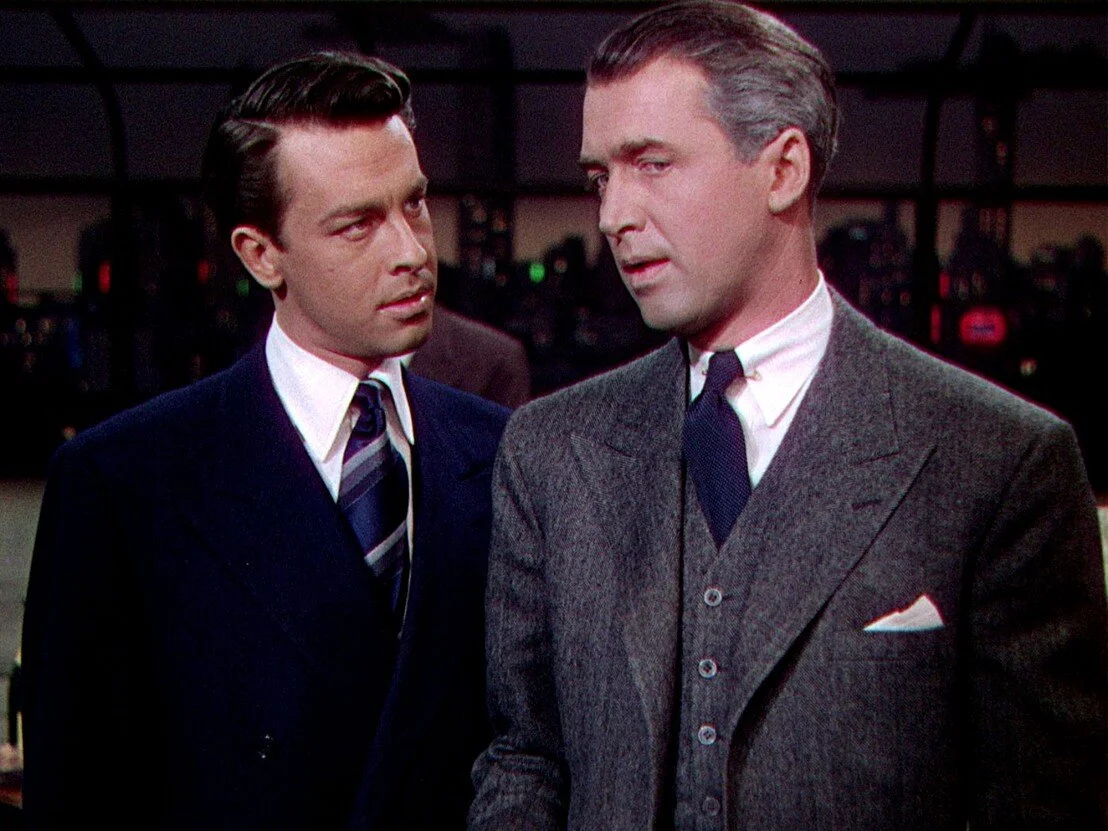
Harvard student and murderer, Brandon Shaw (played by John Dall), converses with his former headmaster (James Stewart).

Harvard student and murderer, Brandon Shaw (played by John Dall), converses with his former headmaster (James Stewart).

And Alfred Hitchcock likely shared an opinion similar to mine. 24 years after Leopold and Loeb’s crime, Hitchcock released the movie “Rope.” The movie tells the story of two Harvard students, who decide to kill a classmate and host a dinner party, literally over his dead body (the murder victim is placed in a trunk, upon which the innocent dinner guests dish their food). These Harvard students aim to prove that they are Ubermenschen. And they think that they’ve finally committed the perfect crime. However, as is characteristic of Hitchcock’s films, justice soon catches up with the murderers. And, just as in real life, it soon turns out that they are not nearly as untouchable as they once believed.

And while the movie is psychologically disturbing and sad, it is also highly intelligent. In just 80 minutes, Hitchcock powerfully indicts any man - murderer or otherwise - who thinks that he is somehow above morality or the law. And while Leopold and Loeb are luckily no longer present on the University of Chicago’s campus, their crime is a relevant reminder that the ideas of famed philosophers, even twisted and misinterpreted as they may be, matter. And they have consequences far beyond Harper or the Seminary Coop. After all, during Spring Quarter every year, UChicago students in Classics of Social and Political Thought read Nietzsche. And we are not the only college students to do so. And while it’s easy to sometimes get lost in the theory of a text, it’s worth noting that the abstract theories we discuss have consequences - far beyond campus’s quads. And sometimes it takes the memory of murder, to remind us.

Click here, for thumbnail image source.

How the Coronavirus is Impacting Fashion: From Face Masks to Delayed Production

As concerns about the coronavirus spread, fashion week attendees have learned to say “hello” differently. Rather than shake hands or “air kiss,” attendees squeeze each other’s arms. The gesture is warm and informal. More importantly, the greeting doesn’t require skin-to-skin contact. And, as Jess Cartner-Morley writes in The Guardian, this gesture is gaining popularity: “The trend sweeping Paris fashion week, which looks poised to catch on globally, is not a hemline or a handbag but a new form of greeting: the upper arm squeeze.”

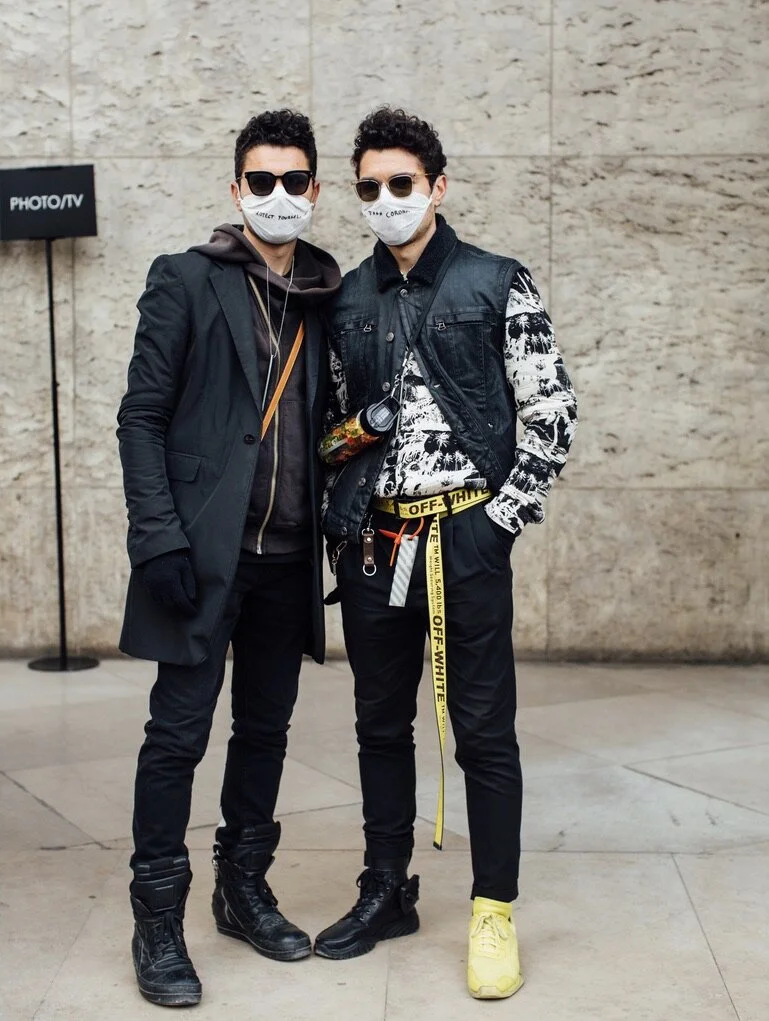
And as Paris Fashion Week attendees greet one another differently, so too do they wear face masks. Due to the demand, the Airinum Urban Mask 2.0 sold out recently in three colors; Gwyneth Paltrow posed on her flight to Paris, while wearing the onyx black version of this mask (see image, above).

Paris fashion week attendees wear face masks at the Isabel Marant show.

Paris fashion week attendees wear face masks at the Isabel Marant show.

An attendee wears a mask at Milan fashion week.

An attendee wears a mask at Milan fashion week.

However, while images of masked-attendees populate the internet, the fashion industry’s response to the coronavirus has been mixed. The Chinese brands Shiatzy Chen, Masha Ma, Calvin Luo, Uma Wang, and Maison Mai all cancelled their Paris shows. Both the Beijing and Shanghai fashion weeks have been concealed. The largest furniture and eyewear fairs, Salone del Mobile and MIDO, have been pushed from spring to June. And Giorgio Armani staged his Milan catwalk show to empty seats; less than 24 hours before the show was scheduled to start, guests were told to watch the live stream, instead. Giorgio Armani himself bowed on stage, before rows of empty seats. Meanwhile, Dolce & Gabbana proceeded with its live show - illustrating the extraordinarily varied responses to the outbreak.

And while the virus continues to impact this winter’s fashion shows, it is also predicted to have long-term economic consequences, within the global fashion industry. The Chinese population constitutes approximately 40% of the world’s luxury fashion house customers. And Bernstein and Boston Consulting Group estimates that the virus could cost the 2020 worldwide luxury industry up to $43 billion.

China produces more garments than any other nation on Earth; the country manufactures over a third of all textiles and clothing, globally. And factories across China are currently closed, due to the virus. Many Chinese manufacturers traveled home for Chinese New Year, and have been unable to return to their factories (due to shutdown public transportation and locked-down cities). And this will impact brands as varied as Prada, Zara, H&M, and Armani.

In her article for Fast Company, Elizabeth Segran bluntly states that all fashion brands that source from China will experience significant inventory delays - meaning that brands will struggle to meet the demand of their shop-floors. And while no one knows the extent to which the fashion industry will be impacted by the virus, it’s clear that the virus’s impact will be significant.

“Paris Street Style”

“Paris Street Style”

Bella Hadid poses with a face mask.

Bella Hadid poses with a face mask.

Click here, for thumbnail image source.

"Overlooked": NY Times Effort to Honor Women

A few weeks ago, the New York Times announced its new project “Overlooked,” to (finally) provide the obituaries that many honorable, historic women have deserved, but were never given. The company’s history of recognizing mostly white, upper class men in their obituary section is starkly evident. In the process, it has left out the stories on notable and accomplished women like Ida B. Wells, Emily Warren Roebling and more who have contributed to the advancement of the arts, sciences and society at large. Even the handful of women who were given obituaries were not properly recognized for their work, and their affiliation with their husbands was often cited.

NY Times editor, Amisha Padnani reveals how “Overlooked” came to be, writing how 2017 witnessed major changes in conversations around race and gender equity; “people were coming out of the shadows to share personal tales of injustice and discrimination, of disparaging and belittling encounters that made them question their sense of belonging in the world" (NY Times). This project became an endeavor to honor these conversations while bringing attention to the high number of women and people of color who deserve to be recognized for their contributions to society.

DXxK7YeWAAEck9W.jpg

In the process of documenting the untold stories of late and recently passed women, the Times has also offered readers the opportunity to submit suggestions on who they think should be honored for upcoming obituaries. The Times has reported that a large number of readers have submitted stories about their grandmothers or other relatives.

The Times’ efforts to highlight important moments in history that were pioneered and driven by women underscores the importance of recognition, especially for groups whose experiences have normally gone uncovered by mainstream media platforms.

William McDonald, a longtime obituary editor for the Times, responded to the looming question as to why many obituary subjects have been disproportionally white men. He writes, “the prominent shapers of society back then… were disproportionately white and male, be they former United States senators or business titans or Hollywood directors… perhaps the paper’s selection standards in eras past unfairly valued the achievements of the white, male mainstream over those of minorities and women who may have been more on the margins" (NY Times). 

This project is undoubtedly overdue in its efforts to align with the cultural and societal shifts currently occurring and the discussions and changes that make room for narratives driven by women, people of color, members of the LGBTQ+ community, disabled individuals, and other marginalized groups. Finally, we are witnessing a major media source engage across culture, sexuality and race to bring light to figures who deserve to be celebrated and whose very identities and successes help break the constraints we too often find ourselves in.

Feature image via

Source: https://www.nytimes.com/2018/03/08/insider...

News for Millennials: The Outline

Through part of one of my many (and frequently abandoned) self improvement stints, I discovered The Outline and have stuck with reading their modern take on current events and newstories. Subscribing to their email subscription list (you can do so too - here!) has upped my morning with current events and incredible graphic design (a refreshing alternative to other news outlets!)

Read More