How do we convey ideas?
Believing that not everything can be verbalized, the concept of language is never enough for me. I have never been good at dubbing my mind anyway… When you try to narrate a memory of yours, have you ever felt that the words you are choosing from your limited vocabulary are just a very bad voiceover compared to what you experienced? That’s what I am talking about. Sometimes when there are less words, it is louder, chattier. What matters is the expression and the experience. At least, that’s what I think.
Since I think of arts as multi-perspectived experiences, arts speak more to me. Arts speak literature, films, notes and lyrics, stitches on fabric, brush strokes on paint… It is not a matter of words. It is a matter of finding the right medium to tell your story.
As these thoughts preoccupied my mind, with my discovery of PAP Magazine, an aesthetic euphoria took over.


PAP Magazine is a digital fashion magazine based in Milan, with editorship and creative directory of Domenico Kang. They publish daily editorials from artists all over the world with contents ranging from fashion shows to philosophical reflections.

“Based on the Asian Philosophy, ‘Moment by Moment Awareness’ demonstrates how people reach self-awareness via meditation. Focus on the story line of 3 Parts <Moment - Disorder - Awareness> represented by Media Art collaborated with fashion”
What is so unique about PAP is how they create their stories. Almost with every content, the observer is drawn into an experience. The artists -and their works- are aware of the fact that if the focus is on only one aspect of the concept, the meaning would be dull. The expression would be lacking the essence. As arts is an experience, the experience of the artist, and therefore of the viewer, would be incomplete. To this end, they blend different mediums in their artistry. When one looks at a work, from the title to photography, from the costume to makeup, the chaos of all these diverse areas tells a story in unity. The observer is absorbed into an ambiance.


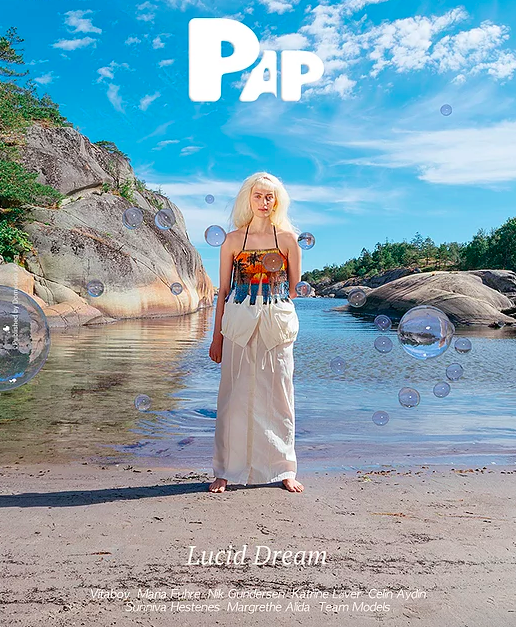


Their contents are not limited to fashion photography. Although an aspect is always the style, there are the decoration and ornament, the model, a storyline, and always but always the moral of the artist. The photography is motionless, yet the observer comprehends that it presents a snapshot of the moment, of the experience of the artists, of the art work. Most of the time, the content is supported by a video, even if the movement of the work is already established.
“URODA means both 'Goddess of Agriculture & ploughed land' in Slavic paganism, and equally translates as the word 'ugly' in the Russian language.
This is a short performance film centred around our issue of ecological crisis; humanity’s overwhelming of the natural resources of the planet and the industrial world has affected not only the health of us and the planet but the psyche and psychology of what it means to be alive, the quality of life and how we live.”
Being a home to many young artists and their works, PAP represents the extraordinary, albeit it appeals to the most familiar experiences. When concentrated on a post, maybe one is unable to tell word by word what that theme is; however, the sense is there. That familiar feeling when you do x or y, it is there. It is in harmony with the aesthetic, proving the unspoken language of fashion, arts, and design. Proving that the creativity appreciates the experience.


I asked how we convey ideas, giving my humble answer, the expression and the experience. Consider PAP as my evidence.
References to the art works:
Thumbnail image via: Drowsy Bloom: Photography by Kim Changjun Styling by Sim Jieun Hair & Makeup by Kim Minyoung Photography Assistant by Kim Kiwoong, Kim Yunju and Kim Taehyung Styling Assistant by Nam Yoonkyung Model by Jang Minyoung
Seasons: Photography by Nina Petko Styling by Darina Kulikova Makeup & Hair by Kate Hrustaleva Model by Anna Photography Assistant by Daria Erantseva & Anfisa Bittner Flowers by Botanica Garden Ceramic by Polina Kamardina Location by ArtKvartira
Moment by Moment Awareness: Photography & Flim by Shin Jae Lee Creative Director & Styling by Boyeon Hur Hair by Eun Hye Jo Makeup by Chakyung Park Executive Producer by Chan Hee Jung Producer by Jun Young Hwang Art Director by Han Sol Lee Media Visual Artist by Jun Hyung Park Styling Assistant by Jinhyuk Kwon Art Assistant by Ha Jung Jang & Ji Hee Choi Photography & Film Assistant by Chang Hwan Oh & Hyo Jung Son Model by Yujeong So & Yoon Lee
Intermixture: Photography & Creative Direction by Rein Kooyman Styling by Amber Aste Hair & Makeup by Xiu Yun Yu Assistant by Aristos Latrou & Laurien Doodeman Model by May Kamara from Solid Model Management
Lucid Dream: Photography by Vitaboy Styling by Maria Fuhre 3D Art by Nik Gundersen Hair by Katrine Løver Makeup by Celin Aydin Photography Assistant by Sunniva Hestenes Model by Margrethe Alida from Team Models
Beauty and Grace: Photography & Creative Directing by Joelle Grace Taylor Styling by Joelle, Grace and Tatiana Makeup & Hair by Tatiana Kazana
Model by Grace Edward
Uroda: Direction by Vasilisa Forbes DOP by Oscar Oldershaw Styling by Vasilisa Forbes Makeup by Daisy Oldershaw AC by James Willmott Talent by Franzine Maria
Homebodies: Art Direction & Photography by Gioia Cheung Styling by Coco Chan Wing Lam Hair by Cheng Po Ki Makeup by Ruby Kh Chan Photography Assistant by Jack Hackett Model by Lucia Lau from Stage Management
Neon: Photography by An Shaoda Video Maker & Art Direction by Chiara Trimigliozzi Styling by Erica Benocci Makeup by Francesca Bechi Hair by Madia Legrottaglie Model by Maria Darts from Fabbrica Milano Management
Retrofantasia: Photography & Directing by June Hyuk Park Styling by Hye Su Jo Hair & Makeup by Hong Ju Sung Model by Bom Kim & Ye Eun Lee