Capsule Wardrobes: Death to Tragic Impulse Buys!

As we continue to bury ourselves deeper into the deep dark depths of fast fashion, greenwashing, and microtrends, the importance of consumer accountability when it comes to sustainable fashion, unfortunately, continues to grow. Not that large corporations and companies shouldn’t be held primarily responsible– they should. But that doesn’t mean that we as consumers can’t play a role in sustainable consumption too. 

There are many ways to go about this, of course. But my favorite? CAPSULE WARDROBES!

You’ve probably heard this term before – or maybe you haven’t. Regardless, capsule wardrobes are truly an essential, not only for those looking to shop more sustainably, but also for those who are trying to cultivate their own sense of style or simply build a closet that is more financially sustainable. 

I, for one, am a shameful victim of microtrends (and trendiness in general). Currently, I have multiple very loud sweaters and many pairs of ill-patterned pants that have all been worn once, or not at all, sitting in my closet: a melancholy reminder of the impulsivity of my quarantine days. Looking back, there are so many pieces that I bought simply for the sake of trendiness, fleeting taste, or even simply because I wanted to “fit in” (enter that one Brandy Mellville dress that was extremely unflattering and extremely expensive for no reason). I would like to think that I have experienced some growth since then, but the truth is I am still learning what exactly my style is, and what pieces classify as justified purchases. For now, though, I will share what I have learned, and what the rest of the world has to say about capsule wardrobes.

So, what is a capsule wardrobe?

A capsule wardrobe is a set of simple, hopefully high-quality, pieces that can be mixed and matched in many ways to create a plethora of looks; think white T-shirts, your favorite pair of jeans, etc. Basics, but with a bit of spice to elevate simple outfits. Essentials. The term, although technically in existence beforehand, was first truly brought to collective consciousness by Susie Faux, a London boutique owner, to describe basics used for mixing and matching in the 1970s. And that’s exactly what it is; a collection of pieces that are able to be mixed-and-matched into oblivion. While the exact items contained within a capsule wardrobe are open to dispute, here are the 6 pieces I believe constitute one (as a college student very much on a budget and very little time to shop):

  1. A pair of jeans. I feel like this one is pretty self-explanatory; everyone deserves a good pair of jeans that feel good and fit well. This is coming from the girl that spent two years in high school wearing exclusively leggings and sweatpants, and now owns denim that fits.

  2. Neutral T-Shirts and/or tank tops. These are essential items for layering, and pairing with more unique pieces that may not be akin to pattern mixing.

  3. A staple jacket(s). Excluding your Canada Goose puffer, a good staple jacket is so so important; for me it's black leather, but it can be anything really.

  4. A couple of crewnecks. Realistically, this is what you’ll be wearing more often than not. I have a vast collection of hoodies and crewnecks that can be dressed up or down. I get made fun of for the quantity of them in my closet sometimes, but I literally wear them everyday.

  5. Something fancy-ish. For me, it's a black dress, for my sister it's a striped jumpsuit. Just a little something in case you need to get dressed up for some reason.

  6. A staple pair of sneakers, a staple pair of boots. Again, I feel like this is self-explanatory. Sneakers for conventionality, boots for fashion and wet weather.

And that’s it. Obviously, all of this should be taken with a grain of salt; I’m just sharing what I have come to appreciate as my own capsule wardrobe, as someone who wants to be more mindful of her purchases.

So, the next time you’re pondering your potential purchase of animal-printed pants, learn from my mistakes and really consider the impulsivity of your actions. Here’s to the gradual demise of microtrends and fast fashion!

Source: https://www.pinterest.co.uk/pin/5507058606...

The Quarantine Hyperfixation that Stuck

Five months after move-in day and I have just about settled into my lovely IHouse single room. A kettle, microwave-fridge-freezer, wardrobe full of clothes, and semi-functioning radiator are now at my disposal. Yet my room is markedly different to my room back in Leeds, England (a 2 hour train ride from London, for those who need a reference); I have no sewing machine here.

Cycling through hobbies - rather, hyperfixations- was one of the things which kept me semi-sane during the various national lockdowns last year and the year before. Between riveting online classes, I started reading fiction for fun again, made some tacky jewellery, and then tried to learn Russian on Duolingo. (I may still have the Russian alphabet keyboard on my phone, but do not test me on anything other than “привет”). Each of these phases lasted for a couple of weeks before I needed to find something else to stop me doomscrolling on TikTok all day.

During my 5-hours-a-day doomscrolling era (don’t judge), my algorithm, which had worked out I was into fashion, kept feeding me thrift flips à la the videos in this compilation. I impulsively bought a sewing machine and decided to start altering and upcycling some of the clothes in the back of my wardrobe.

My first sewing machine. Featured image via (yes, sorry, it was from Amazon).

I bought this sewing machine and it served its purpose for a while, honestly. It even came with pre-wound bobbins. After a year almost daily use and abuse, RIP this sewing machine though (2020-2021).

My aim was to teach myself how to sew from scratch, and after allowing myself to watch one (1) YouTube tutorial on how to thread my machine, I began by hemming a pair of trousers which I would previously have to awkwardly roll up, and thus rarely wore. Lots of tedious stitch unpicking and re-sewing later, I had a now wearable pair of trousers.

After staying up for hours at a time wrestling with my machine, and upcycling the clothes I already had, I set myself a goal of making something from scratch. When my local charity shops reopened, I bought a baby pink bedsheet which would form the basis of the next stage of my sewing obsession. I started with a tote bag, then another tote bag, this time with better stitching, and then yet another tote bag for my little sister (my first client??) because she liked the ones I made myself. Then, I made my first pattern and constructed a corset top from that same cotton bedsheet. It was pretty rough but, after that, I was inspired to buy some fabric in a colour I would wear (those who know me know that I only wear dark pink, green, or purple monochrome outfits). After a few more hours, I now had a purple flower print corset top complete with bias binding and a lace up back!

You may be wondering why this hobby stuck and others didn’t. For someone who gets bored easily, I was also surprised. Some may think it is the sunk cost (hi econ majors) of the sewing machine, fabric, thread, et al., but it was more the sense of guilt I felt that I owned many clothes that I hardly wore because they didn’t fit me correctly. The coalescence of being an impulse purchaser (I’m working on it, don’t worry) and my intense reluctance to get rid of anything I have bought, left me with at least half of my wardrobe being almost unwearable.

Learning to sew was my first significant step towards slow fashion. Instead of buying a cheaply-made top that I kinda liked from a fast-fashion brand, I could now make the exact item I envisioned for myself by upcycling charity shop finds or from fabric I bought from a local craft store. When I wear an item I have made, I feel proud and confident- and the serotonin increase I get when someone asks me where it is from is unparalleled. I have started to curate my personal style, while still engaging with some current trends in a more sustainable way by upcycling and making clothes from scratch.

Sadly, the hotel sewing kit my mum brought me when my family came to visit Chicago recently is all I have for now, but I cannot wait to return home this summer to my new sewing machine- which actually has a warranty (but no pre-wound bobbins :/)- this summer.

How Fashion is Shortchanging Global Garment Supply Chains During Covid-19

Covid-19 has obviously presented the world with challenges like never before. As industries, schools, businesses, and communities adapt to life during the pandemic, they prove to be a source of innovative ideas when it comes to coping with working remotely. Too often the news coverage we see is either focused on the crisis itself or the positive news of large brands making long-demanded changes to their company practices. The flip side of shiny rebranding initiatives, however, is the impact on the unprotected workers in the very bottom of global supply chains. 

I’m willing to bet that throughout your own social distancing experience you have noticed the sudden uptick in retailer’s large scale sales up to nearly 70% off. This is no coincidence. In a time when the demand for new clothing is relatively low, companies are having an increasingly difficult time to meet their predicted number of garment sales. The unprecedented combination of employment uncertainty and lack of places to physically go to during the pandemic has resulted in reduced clothing purchases. 

Multi-billion dollar corporations and global luxury fashion retailers can absorb many of these losses in sales, but many fast fashion brands that rely on a massive supply of inexpensive garments are lessening the strain on their companies at the expense of some of the most vulnerable people around the world. 

Garment workers in Bangladesh via

Garment workers in Bangladesh via

A research paper written by Dr Mark Anner published by the Center for Global Worker’s Rights found that more than half of clothing suppliers in Bangladesh had their orders canceled, many of which were already completed or in-process. Of those canceled orders, approximately 72% of buyer corporations refused to pay for the materials that were purchased in advance for these orders. Over 91% of buyers refused to pay for the production cost of these goods. Why is this so impactful? Let’s break it down. 

The global garment production industry food chain is composed of you (the consumer), the fashion retailer (store or brand you purchase clothing from), the garment supplier (factory), the raw materials supplier, and the factory workers. There are obviously other jobs and services involved in this process, such as shipping, marketing, etc, but for simplicity's sake we will use this rough schematic of how your clothing ends up in your closet. When clothing brands design a specific article of clothing, they send an order to their garment suppliers (factories), indicating the materials to be used, the amount of the particular item to be made, and the compensation for the materials and labor necessary to create the garment. The critical thing to understand in this process is that most companies pay for the goods only after they have been received. That is, factories must pay upfront for the raw materials necessary to create the clothing and get compensated for the expense only after the goods have been shipped to and received by the retailer. The factory must also pay its workers for their labor in creating the clothing you wear. The compensation for this is also settled after the clothing has been made and delivered. 

Via

At the beginning of the Covid-19 pandemic, Chinese factories were put under strain. As many cities and provinces in China shut down to prevent the spread of Covid, production lines were interrupted, causing the delay of raw materials delivery to other factories responsible for garment production. The disruption of the supply chain caused subsequent delays in garment production in places like Bangladesh and Cambodia. This disruption in the supply chain can be penalized by the buyer (fashion retailer or brand). In fact, over 50% of factories in Bangladesh reported that the buyer took a fine out of their payment for the delays caused in producing the goods. Furthermore, the majority of factories reported that the cost of raw materials during this time increased. At the same time, nearly 92% of factories reported that their buyer has not adjusted their payments in accordance with the increase in price of raw materials. In effect, garment suppliers are paying the extra cost of raw materials and are forced to pay for a fine due to the delay in production while the international fashion retailer refuses to cover the additional expenses incurred...in the middle of a pandemic. 

Via: https://www.workersrights.org/research-report/abandoned-the-impact-of-covid-19-on-workers-and-businesses-at-the-bottom-of-global-garment-supply-chains/

Via: https://www.workersrights.org/research-report/abandoned-the-impact-of-covid-19-on-workers-and-businesses-at-the-bottom-of-global-garment-supply-chains/

If that doesn’t sound harrowing enough, I’m sorry to say that it gets worse. As the economic impact of the pandemic began to set in, buyers began to cancel their orders, including those already in production. To put it in perspective, Bloomberg estimates that the cancellations of orders were worth over $1.5 billion by April alone. Naturally, this forced many factories to close because they often times operate on narrow margins. Having never received compensation for the raw materials or the labor involved in the manufacturing process, they subsequently are forced to put many people out of jobs and leave families without primary sources of income. This, among other actions, technically broke contractual obligations on the side of the buyer. But for many factories and their workers there were no means of recourse. 

Via: https://www.workersrights.org/research-report/abandoned-the-impact-of-covid-19-on-workers-and-businesses-at-the-bottom-of-global-garment-supply-chains/

Via: https://www.workersrights.org/research-report/abandoned-the-impact-of-covid-19-on-workers-and-businesses-at-the-bottom-of-global-garment-supply-chains/

As of October 2020, an estimated $16bn worth of goods have been unpaid for by retailers, forcing many overseas garment suppliers to permanently shut down and leaving millions of workers without compensation. The current garment supply industry heavily favors the buyer, leaving the suppliers to take on all the economic risk associated with producing clothing. Even so, many companies now are still trying to find loopholes in their contracts to avoid being responsible for their practices on both the economic and safety fronts. 


Popular fast fashion retailer ASOS has come under fire for insufficiently protecting the health of their factory workers. In factories that regularly employ approximately 4,000 people, ASOS is reported to have limited safety precautions in place and the supply of personal protective equipment is insufficient to prevent the spread of Covid-19. The company is not the only one with shady practices during Covid; as of October 1, 2020, JCPenny, Kohl’s, Walmart, Balmain, Oscar de la Renta, Anthropologie, Urban Outfitters, Topshop, and T.J. Maxx, among others, have failed to make commitments to pay for completed orders cancelled during production

While the tumultuous 2020 has caused many retailers to consider their social impact, collectively, the industry shows to be resistant to change. As Dr. Mark Anner at the Center for Global Workers Rights puts it, “All parties are feeling the extreme burden caused by Covid-19. However, not all parties are equally situated to find the liquidity needed to cover their expenses.” Specifically, it is the irresponsible and unethical practices of global retailers, fueled by the purchases of the unawares consumer, that causes damage and instability to communities the world over. The recent uptick in companies rebranding as sustainable and accountable should raise concern in consumers as company malpractice continues during Covid. It’s incredibly easy to proclaim that a company has taken a stance on racial justice or the environment, but it is a lot more difficult to follow through on those promises or to extend the same privileges to minimum wage workers overseas, who often pay the tremendous personal costs in times of crisis and remain largely unseen and uncompensated. 

For more information on tracking the accountability of major corporations, take a look at the Workers Rights Consortium’s project and Covid-19 responsibility tracker here.


Cover image via.


COVID-19's Effects on Fast Fashion

As the coronavirus spreads, so does its impact on fast fashion.

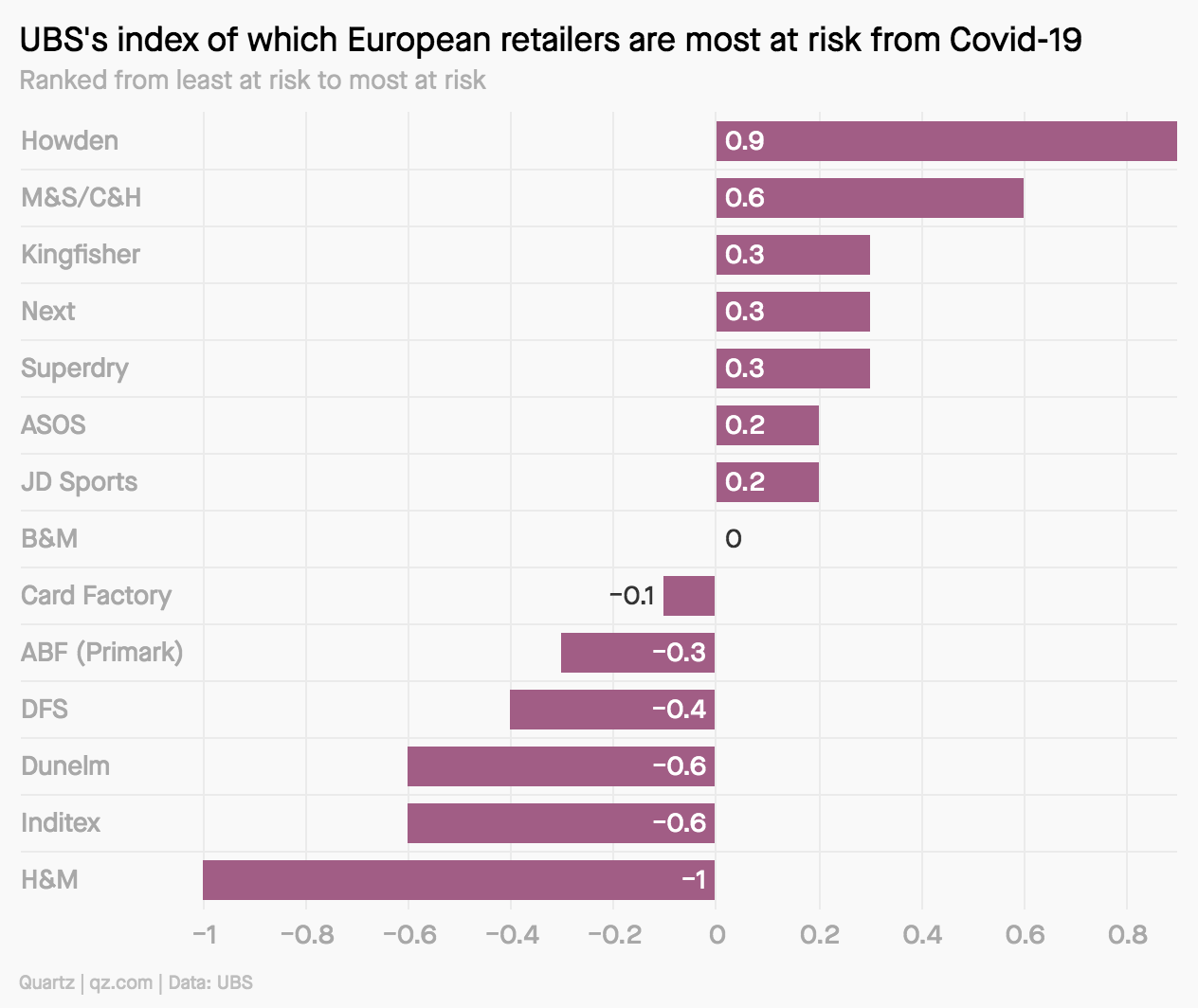
Due to COVID-19, the trend-focused fast fashion business is in peril. It struggles to cope with supply chain issues and weak demand, as many fashion retailers are dependent on China as both a source of cheap manufacturing and a giant consumer market. According to an analysis by UBS, fast fashion’s two giants, H&M and Zara, could be especially vulnerable. The coronavirus has caused delays in the manufacturing supply chain. Margaret Bishop, an expert in apparel supply chains, states, “the timeline from design to delivery in fast fashion has been very significantly compressed, so there’s not a lot of extra time that if there’s a delay of some sort, you’ve got some margin built in.” Retailers with a high stock turnover, such as those in the fast fashion industry, are likely to be impacted sooner than those with low stock turnover.

Image via Forbes

Image via Forbes

Additionally, the COVID-19 lockdown measures implemented across the globe have altered consumers’ shopping behaviors. As people adjust to their new routine of staying at home, they seek comfort and practicality. For instance, shoppers are showing increased interest in certain items, including loungewear, lingerie, activewear, and home decor. According to Stylight, hoodies (13%), sweatpants (27%), and leggings (15%) registered a surge of clicks in the last two weeks of March. 

Image via Boston Globe

Image via Boston Globe

With worldwide store closures, many brands are using online sales as a tactic to draw in customers. Nevertheless, revenue is plummeting at every level of the supply chain, and workers are feeling the effects. Millions of garment makers and retail workers have already lost their jobs due to the virus, often with no financial safety nets. Some brands such as ASOS and BooHoo have come under fire for the pressure they put their warehouse workers under. Many warehouse workers feel unsafe during work, claiming there is “no social distance, not enough sanitizer.” 

At the same time, key players in the fashion industry have been rising to the occasion, from funding efforts to fight the virus to converting facilities to suit the needs of healthcare workers. For instance, Uniqlo has announced a donation of 10 million masks to medical institutions around the world, particularly in countries struggling with high infection rates. Fashion Nova, meanwhile, has launched a charitable initiative in partnership with Cardi B called Fashion Nova Cares. The online retailer recognizes that many are struggling to support themselves and their families. Steps it has taken to help out include selecting 24 applicants each day to distribute individual checks and giving away 1000 dollars every hour until May 20th. 

Image via CNBC

Image via CNBC

This crisis can serve as a moment of reflection and transition for the industry. It could lead to fundamental changes in how and what brands sell to consumers. In fact, even before the coronavirus, more people have realized that they do not need new clothing as much, indicated by the rise in resale. Millennials and Gen Zers, in particular, increasingly enjoy thrift and consignment stores. The secondary market for fashion has grown overall as more people have become aware of fast fashion’s detrimental environmental effects and exploitation.

With COVID-19 bringing questions of industry support and reformation to the forefront, now seems like the perfect time to have a conversation about redesigning the current fast fashion model, one that will hopefully guide the industry towards new opportunities in tackling challenges of climate change, overproduction, and workers’ wellbeing.

Featured image via