Welcome to Cabinet of Curiosities, my new series on the blog that unpacks the distinctively Gothic imagery that permeated Avant-Garde Fashion shows at the turn of the new millennium! From sanitariums to sanctums, from highwaymen to vampires to ghosts, the worlds and figures of this fashion moment seem like something straight out of a novel, and yet through the space of the fashion show, the novel takes an entirely new form. This series aims to unpack this 21st century Gothic revival as a symptom of something larger beyond the stage of the catwalk, and more broadly, prod at why fashion, in particular, became a major vehicle of this revival. This is the Cabinet of Curiosities, a tour of our world told through the haunted remains of collected objects.
Okay, welcome back; i know it’s been a while, but I promise I’m back on my odd blog-thesis hybrid project. I’m glad that at least I have the blog and our very special audience to validate my correlation between fashion and a novel kind of literature, but I do feel like for the less textually daring readers out there, I do need to defend my central argument a bit.

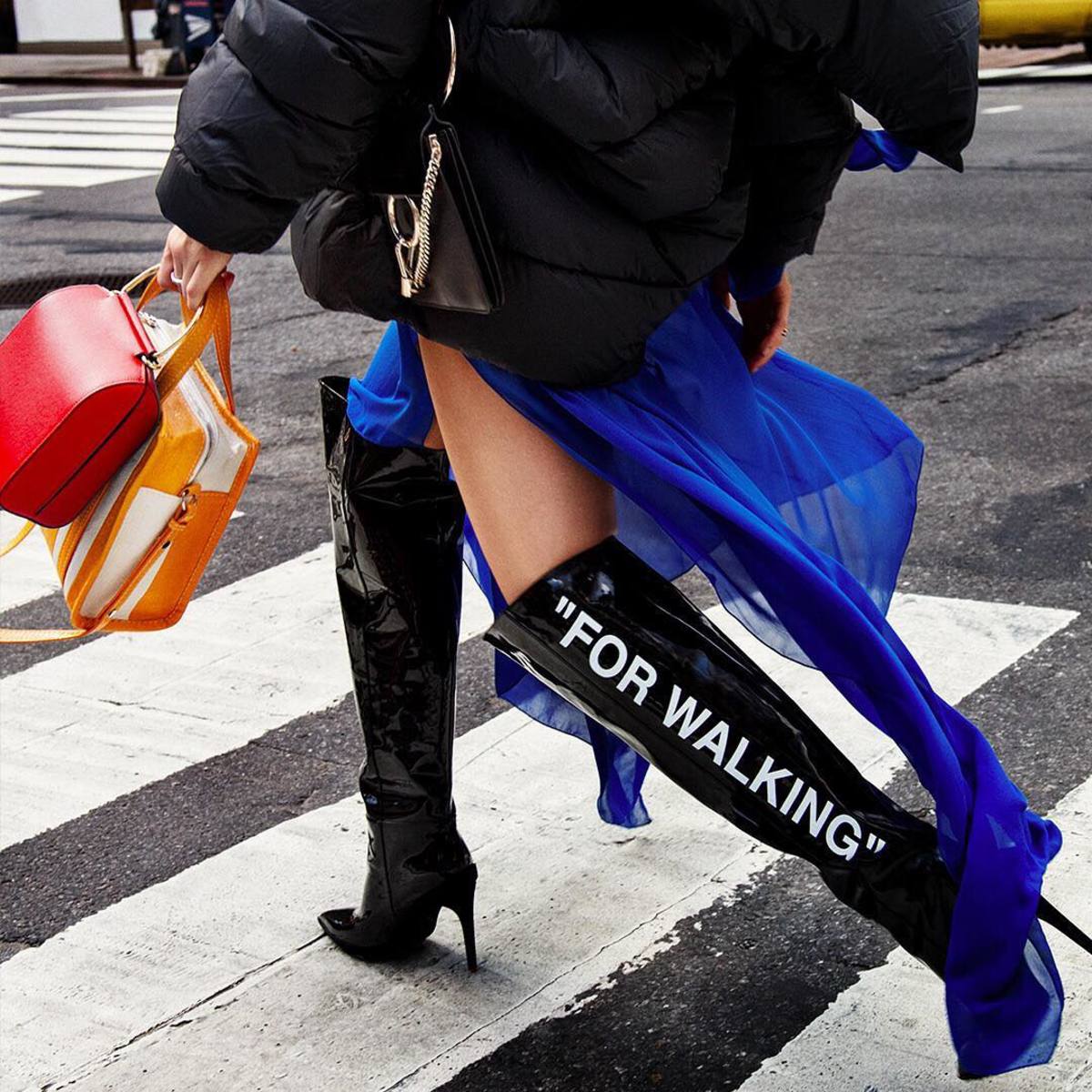

I might not be able to read too many texts at once, but I can definitely read all of these clothes! Labelling, popularized today by Off-White’s Virgil Abloh and Dolce and Gabbana back in the day, is one way in which fashion on the runway tries to make explicit the semiotic relationship between a garment and it’s function, connotation or intention.
This project centers on a very prominent question of narrative medium. To see the speechless form of fashion shows as a kind of reinvention of literary tropes from 19th century novels challenges the convention that narrative is rooted in a system of written or oral language. That isn’t to say that fashion shows are entirely devoid of linguistic assistance, as many shows often offer their audiences some kind of written statement to contextualize the spectacle, but it is evident that the fashion show is largely presented visually and without the guiding presence of language that seems to epitomize narrative, and so fashion’s role as a storytelling object may seem dubious.
HOWEVER, despite fashion’s limited speech, show season is perpetually surrounded by a discourse of literary vocabulary, describing the distinct narratives, settings and characters of each show. As an example, in describing her role in the Dior 1999 Haute Couture show, model Marisa Berenson exclaimed: “well I was the mother of the bride, and it was a rather unhappy family. Very grand, very aristocratic, very embittered by life.” More contemporarily, and bringing in yet another Drag Race reference, who could forget Kennedy Davenport’s crystallized “death-becomes-her” runway narrative???
This implication that mute garments somehow articulate some kind of persona may seem unusual, and yet, the notion that clothing communicates something worldly or expressive is evidently the foundation of much of fashion publishing from the past century and beyond.
An early theorist on fashion’s capacity to communicate ideas was semiologist Roland Barthes, who probed at fashion’s system of communication in many of his works. In an essay for the Revue Françise de Sociologie, titled ‘Blue is in Fashion this Year’, Barthes writes: “When I read in a fashion magazine that the accessory makes spring time, that this women’s suit has a young and slinky look, or that blue is in fashion this year, I cannot but see a semantic structure in these suggestions (...) I see imposed upon me a link of equivalence between a concept (spring, youth, fashion this year) and a form (the accessory, this suit, the colour blue), between a signified and a signifier”. This semantic structure went on to be the focus of Barthes’ seminal work on the topic, The Fashion System, which tracks the written tendency to use fashionable clothing as objects onto which immaterial characteristics are imposed. Throughout The Fashion System, Barthes elucidates how clothing is rarely the speaker, or generator of meaning, but rather a mouthpiece through which fashion authorities (editors, designers, etc) articulate their particular ideals, often in an attempt to imbue these garments with special meaning to make them more desirable commodities. And while he conducted this study in the mid 20th century, much of the same discourse purveys well into the 21st and onwards, though through a shift in the constitution of fashion authority.

The man, the myth, the legend himself, Roland Barthes and his ever-present cigarette.
The digital age brought about a novel system of writing about fashion beyond the scope of magazines (of which there were many). From personal fashion blogs to YouTube channels dedicated to fashion analysis, to entire programs of study dedicated to the reading of fashion as texts, the discourse on fashionable garments expanded to no end, and yes that includes our favorite fashion blog, MODA Blog ;)
“The goal of the literary work (of literature as work) is to make the reader no longer a consumer, but a producer of the text”
Evidently, much of this writing still falls within Barthes’ initial system of fashion semiology, conflating garments to worldly signifieds beyond the realm of clothing. Furthermore, this widespread fascination with interpreting fashion goes on to epitomize Barthes’ initial constitution of writerly texts, which he unpacks in his analysis of Balzac’s Sarrasine, titled S/Z. In S/Z Barthes posits that the value of a text comes from its plurality, such that “the goal of the literary work (of literature as work) is to make the reader no longer a consumer, but a producer of the text”. He goes on to affirm that “To interpret a text is not to give it a [...] meaning, but on the contrary to appreciate what plural constitutes it”. When applied to fashion, it is apparent that the wide system of interpretation suggests that fashion objects are constituted by a kind of plurality, but at the same time, these interpretations are the sum of individual and unique readings of these objects, and so in order for fashion to fall within Barthes’ definition, this system of fashion interpretation must be seen as not an imposition of meaning onto garments, but rather an acknowledgement that within a fashion object, there is a multitude of potential meanings, that the meanings imposed onto fashion are infinite and unfixed.
In case you wondering how fashion continues to match clothes and anything but clothes. Highlights include “I found myself thinking about Richard Nixon’s daughter Tricia, and what she might wear as a debutante, especially if she was going to Disneyland.”
To bring in the earlier discussion on narrative, an evolution on Barthes’ system is to complicate the semiotic system by directly conflating garments with narrative elements. Rather than just drawing a line between a garment signifier (black dress) and an immaterial quality (flirtiness), several lines are drawn between the pieces of an ensemble to form one larger signified character or storyline. We can understand Kennedy Davenport’s earlier interpretation of her garment as a case study for this, in which she conflates her show ensemble to a distinctive persona, milieu and history, embodied in the elements of the garment. Around the late 21st century, a handful of narrative-focused fashion designers such as Alexander McQueen and John Galliano would make use of this technique to describe their shows, and much of their brand identities became rooted in a hybrid of fashionable garments, spectacular presentation, and embedded narrative, which may have been brought to the audience through invitations, or press.
This series expands on this methodology to close-read a handful of fashion shows revealing lines between vestimentary elements and immaterial, narrative signifieds. Specifically, I hope to bring the avant garde material garments of these fashion shows directly into conversation with immaterial concepts spawning from 19th century fiction and discourse. This may involve drawing a line between certain fabrications, textiles or silhouettes and imagery, language or themes from 19th century novels, ultimately to unpack how these show elements mediate uncertainties around cultural shifts centering on the relationship between consumer and commodity. These close-readings are informed and supported by discourse surrounding both the late 20th and early 21st century fashion scene, but also discourse around 19th century art and literature with the aim to illustrate how this thematic likeness between the discourse of these two eras reveals a succession between the two eras’ narrative media, and introducing fashion into the literary realm, and vice versa.

thanks to anyone who stuck around to this part, y’all are real ones.
featured image via